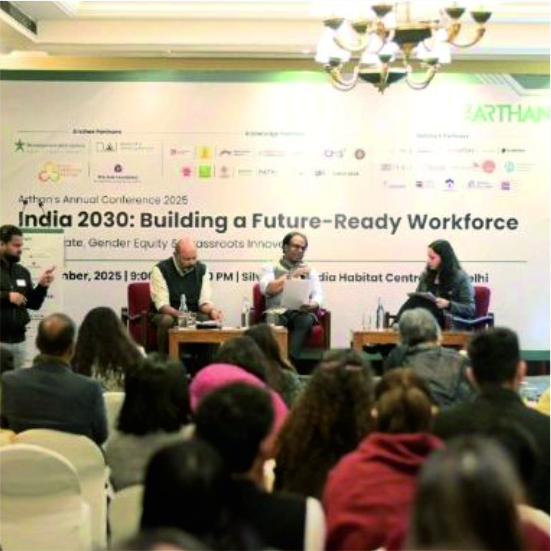
Multi-stakeholder dialogue on equity, climate, capital, and future workforce.
#InclusiveEntrepreneurship
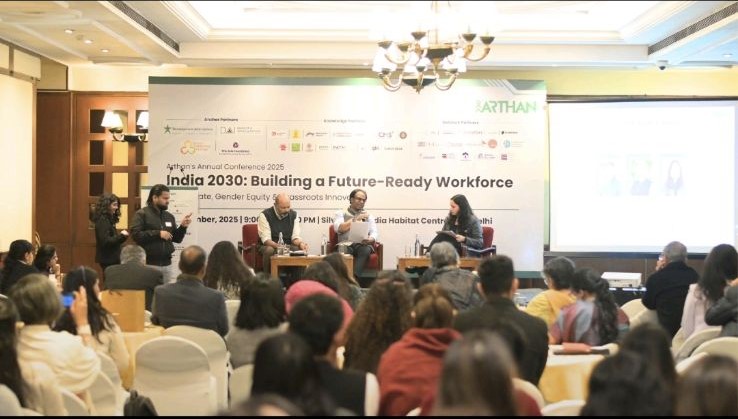
Panel Discussion in collaboration with DAI Research: Bridging the Gap: Making Employment Work for Youth and Women through Evidence-Based Policy
Arthan’s Annual Conference 2025, held on 5 December 2025, convened funders, practitioners, researchers, and civil society leaders to interrogate a defining question for India’s development trajectory: What does it take to build a future-ready and inclusive workforce?
Rather than focusing narrowly on jobs and skills, the conference examined who designs work, who sets priorities, and how power, capital, and policy shape livelihood outcomes – particularly for rural communities, women, and youth. Across panel discussions, a recurring concern emerged: the widening gap between rising aspirations and constrained employment opportunities, pointing to the limits of fragmented, supply-driven solutions.
A panel on green and equitable work re-framed climate transitions as a social challenge as much as an environmental one. Speakers argued that high attrition in rural employment is often misread as individual failure, when it in fact reflects deeper structural mismatches between work design, local realities, and community aspirations. Climate-aligned jobs, they noted, must be co-created with communities if they are to be dignified, durable, and inclusive. Discussions held in collaboration with DAI Research reinforced the role of evidence-based policy in addressing persistent labour market barriers. Gendered care responsibilities, restrictive social norms, and unequal access to resources continue to shape who participates in the workforce and on what terms – underscoring the need for policy responses grounded in lived realities rather than assumptions.
In a Development Alternatives–led panel on Reimagining Local Economies, Shrashtant Patara, CEO of Development Alternatives, and Arun Maira, author and thought leader, emphasised ecosystem-building, community agency, and systems integration as the foundations of scalable entrepreneurship. Their reflections highlighted that enterprise growth is most resilient when local institutions, markets, finance, and knowledge systems evolve together.
Sessions with the Centre for Catalysing Change (C3) brought this approach to life through examples of women-led micro-enterprise ecosystems in Bihar, while panels with the Gates Foundation and The Asia Foundation explored how capital flows, trust-building, and gender equity influence long-term development outcomes.
The conference closed with a clear takeaway: placing dignity, resilience, and inclusion at the centre of development is not just an aspiration – it is a prerequisite for sustainable impact.
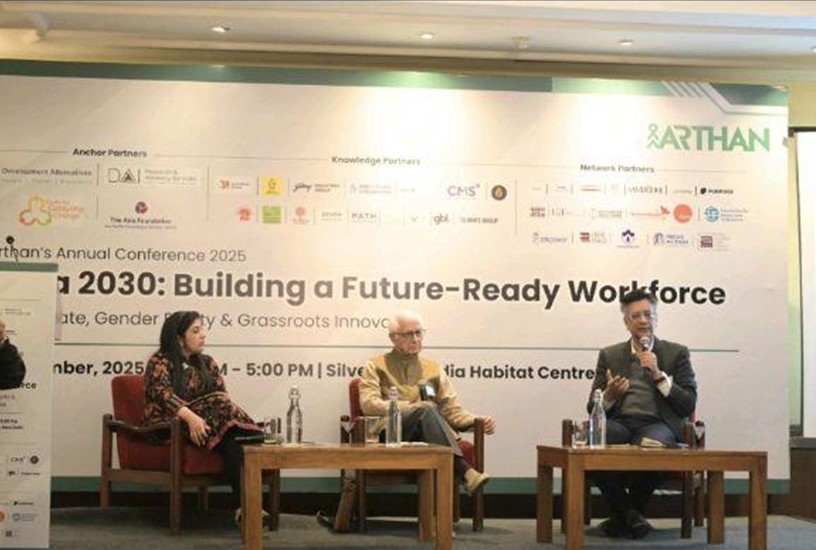
Panel Discussion in collaboration with Development Alternatives: Reimagining Local Economies: A Systems Approach to Inclusive Entrepreneurship
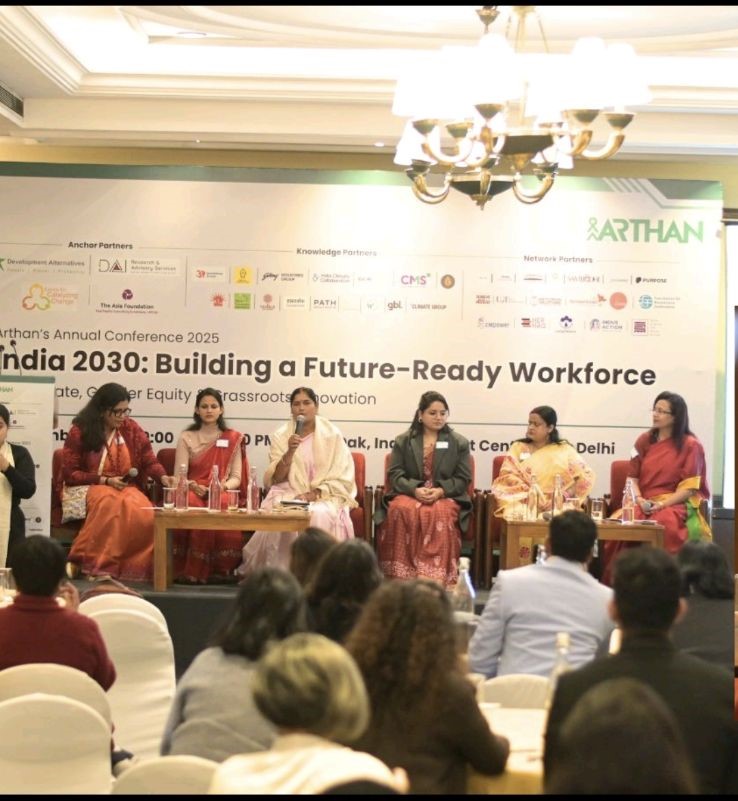
Panel Discussion in collaboration with Centre for Catalysing Change (C3): Trail Blazing Rural Women Micro Enterprise Ecosystem – Stories of Impact and Resilience from Bihar






 Live Radio